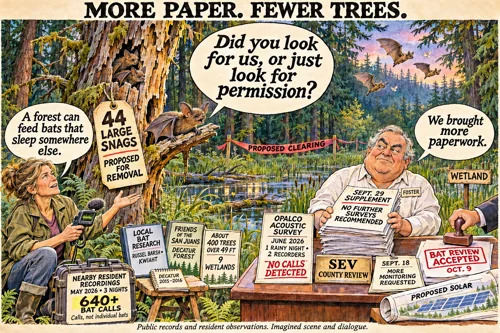
A new letter in San Juan County’s project file asks a straightforward question: has OPALCO’s bat investigation actually answered what the County needed to know?
The letter, posted on October 29, asks Community Development Director Sev Jones to reopen the review of Condition 8, bring KWIAHT Director Russel Barsh into the discussion, and explain how the County’s independent reviewers reached their conclusions.
The County acknowledged the letter and supplied the existing reports. It also confirmed that tree removal cannot occur until the project’s conditions are met and appeals settled. The posted response does not address Barsh’s scientific criticism or explain whether the County will reconsider its determination.
There is still an opportunity to answer those questions while the forest stands.
01 Listen to the expert
The local expertise is here.
Put it to work.
For more than a decade, Russel Barsh and KWIAHT have helped the San Juan Islands understand their bats through field research, acoustic monitoring, roost observations, and public education.
Barsh’s perspective comes from sustained observation of island bats. KWIAHT’s work includes a 12-year record at Hummel Lake and comparable monitoring at several other locations across the islands, in cooperation with WDFW and USGS. Its recorders operate throughout the year because bat activity can change substantially from night to night and season to season.
His published research documents a central difficulty with Townsend’s big-eared bats: visual observations can reveal a presence that acoustic recordings substantially underrepresent. Knowing how to look matters.
That expertise is directly relevant to Decatur. Barsh helped introduce island residents to bat monitoring, and KWIAHT supported a preliminary survey on Decatur in 2016. He brings knowledge of the islands’ bats, their movements, and the limits of the methods used to study them.
OPALCO’s own consultant draws on that knowledge. Environmental Science Associates’ September supplemental report cites Barsh for regional Townsend’s population estimates and known roost locations.
His concern therefore deserves particular attention: he questions whether the investigation was designed in a way likely to detect Townsend’s bats using or passing through the property.
Barsh is equally clear about what he has not established. He has not confirmed Townsend’s bats on the project property. He identifies moth production as evidence of habitat value and visual observation of roosting or feeding bats as the strongest evidence of actual use.
That precision is a reason to listen. He distinguishes what is known, what remains uncertain, and what evidence would help resolve it.
The County should bring that expertise into the review and address his concerns directly.
Sources: Barsh’s published research; October correspondence; ESA’s September supplement, page 3.
02 Confront the gap in the review
OPALCO’s explanation changed.
What resolved the feeding question?
The distinction between a place to roost and a place to feed is central to this review.
ESA examined 44 large standing dead trees and concluded that they lacked suitable Townsend’s roosting features. But Condition 8 also addresses whether Townsend’s bats feed on the property.
A forest can feed bats that sleep somewhere else. Barsh describes watching Townsend’s bats leave a barn roost on Lopez and fly into nearby moth-rich woodland to feed. That observation illustrates why examining potential roost trees cannot, by itself, resolve the feeding question. It does not establish Townsend’s use of the Decatur property, but it explains why the forest’s potential role as feeding habitat deserves separate examination.
ESA’s July report described deploying two acoustic monitors to investigate feeding activity. Monitoring lasted one rainy, moderately windy night. No bats were detected.
The problem is more fundamental than one rainy night. Barsh cautions that acoustic monitoring can miss Townsend’s big-eared bats even when it continues year-round. His laboratory uses night-vision and infrared observation to help distinguish bats passing through an area from bats feeding or drinking there. The method must be capable of answering the question being asked.
The County identified shortcomings in the feeding assessment and requested supplemental information.
ESA’s September response then characterized the acoustic monitoring as opportunistic and said its conclusions did not depend on those recordings. It relied instead on habitat characteristics, the absence of documented Townsend’s roosts on Decatur, regional population information, and OPALCO’s proposed avoidance measures. It recommended no further surveys.
On October 9, the County accepted the reports together as satisfying Condition 8.
The explanation became more extensive.
No additional field surveys were reported.
ESA’s habitat argument deserves examination on its own terms. It acknowledges that Townsend’s could pass through or feed opportunistically over the property, while concluding that removing the identified snags would not adversely affect them. It also points to commitments concerning pesticides, wetlands, and retained vegetation.
The question is whether those conclusions adequately resolve the feeding inquiry. How does the absence of a documented roost establish the likelihood of feeding on this property? How was the regional information applied? What evidence supports the conclusion about removing the trees?
Citing Barsh’s work does not establish that he endorses those conclusions.
The County says third-party experts reviewed the supplement. The letter asks who they were and what they said. Publishing their assessments would let the public understand how the County resolved the concerns it had raised.
These questions need a scientific answer before the determination is relied upon to permit irreversible removal.
Sources: ESA’s July memorandum, page 2, and September supplement, pages 3–5; Barsh’s scientific comments; County correspondence and attached review records.
03 Bring in the wildlife specialists
The state's solar specialists were unaware of this project.
On October 30, WDFW's Solar and Wind Unit told us it was not aware of the Decatur solar project.
WDFW's published guidance calls for early coordination and field assessments that characterize wildlife and habitat. It provides a useful framework for asking what evidence this review still needs.
ESA's one-night acoustic non-detection, and its later reliance on habitat reasoning, should be considered alongside Barsh's concerns about detecting Townsend's bats and identifying feeding activity. The County should ask the appropriate WDFW specialists what site-specific methods and evidence would resolve that question.
Receiving a link to general guidelines is not a project-specific scientific assessment. The response does not say WDFW reviewed or endorsed ESA's methods, and it does not establish that the agency as a whole was uninvolved.
Publish the consultation record. Ask the right specialists. Resolve the feeding question before clearing.
Sources: WDFW's 2025 solar and wind guidelines (PDF) ↗; October 30 response to Island Neighbors for Conservation, summarized here. Read the broader forest and siting questions. The request for further review is ours.
04 Why every island should care
This matters beyond Decatur.
Friends of the San Juans has already highlighted the bat issue in its public account of Decatur’s forest. Its report places the survey alongside the standing trees, wetlands, and other wildlife habitat at stake. It also contrasts ESA’s lack of detections with more than 640 bat calls recorded nearby over three nights. Those recordings demonstrate nearby bat activity. They do not establish Townsend’s presence or show that bats were feeding on the project property.
The forest’s value includes the living relationships it supports. Barsh’s observations about moth production and feeding habitat help explain why examining potential roost trees alone cannot settle every question about how bats use a landscape.
There is also a wider question for County decision-making: what standard of investigation should islanders expect when potential wildlife habitat stands in the way of development?
We believe accepting this review without publicly resolving the methodological concerns risks setting a weak example for future habitat assessments. Residents throughout the islands have an interest in a process that tests the evidence, explains uncertainty, and draws on relevant local expertise.
The letter offers a practical way forward. Reopen the review. Invite Barsh’s participation, if he is willing, alongside appropriate WDFW specialists. Publish the independent reviewers’ written assessments. Identify what further information is needed and how it should be obtained.
The County has confirmed that clearing is not yet authorized. It should use that opportunity to address the science.
Sources: Friends’ forest report, PDF page 14; Barsh’s scientific comments; October 29 correspondence and County response. The call for reconsideration and the concern about future reviews are our analysis.
Read the record
Sources and correspondence.
- County public record / October 29, 2026
October 29 correspondence and County response ↗
The posted email exchange includes a request to reconsider the bat review, Sev Jones’s referral, Darcie Nielsen’s response, and the reports supplied by the County. This is an Outlook email file (.msg), which may download rather than open in your browser.
- KWIAHT / Published research
Barsh’s research on bats of the San Juan Islands (PDF) ↗
The study reports 2014 acoustic monitoring and observations from cooperating island residents, including the importance of visual observations when assessing Townsend’s bats.
- Environmental Science Associates / July 16 and September 29, 2026
ESA’s bat memoranda, attached to the County’s response ↗
See page 2 of the July memorandum for survey methods and results. In the September supplement, page 3 cites Barsh and presents the regional-roost and foraging reasoning; pages 4–5 explain the role of acoustic monitoring and recommend no additional surveys. The County’s September review and October 9 acceptance are also included in the posted exchange.
- Scientific correspondence / October 23, 24 and 28, 2026
Russel Barsh’s scientific comments, October 2026
Barsh’s comments on long-term monitoring, survey methods, the preliminary 2016 Decatur survey, visual confirmation, and moth-rich feeding habitat inform the summary above. The public letter quotes his methodological concern. These comments address survey methods and habitat questions; they are not presented as a review of every part of ESA’s supplemental analysis. KWIAHT’s role is research, stewardship, and education. The advocacy and requests on this page are those of Island Neighbors for Conservation.
- WDFW / Published guidance, September 2025
Solar and wind development guidelines (PDF) ↗
Agency guidance on consultation, wildlife and habitat assessment, and avoiding and reducing impacts. WDFW's October 30 response is summarized in this article; the email itself is not published here.
- Friends of the San Juans / October 2026
Decatur forest report, PDF page 14 ↗
Friends’ public report addresses bats and other wildlife alongside the forest, wetlands, soil, and drainage. The statement about the implications for future County reviews is our analysis.