01 Washington DNR · October 26
Decatur Island · Fire & emergency response
Fire: now what?
The record raises questions his letter does not answer.
Three fire districts have responded: San Juan Island (FD #3), Lopez (FD #4) and Shaw (FD #5). Read their accounts below.
02 San Juan Fire #3 · November 9
Its response confirms
No agreement with OPALCO
for specialized fire, rescue or emergency services.
Read the chief’s response03 The County’s own plans
Serious
response gaps.
Transportation delays. Water-supply limitations. Potentially inadequate fire protection.
The wildfire plan’s Decatur profile also identifies the absence of coordinated emergency communications and response planning for the outer islands.
Read the County’s own account04 Lopez, FD #4 · November 9
His questions
went unanswered.
Chief Adam Bigby
Lopez Island Fire & EMS
Chief Bigby states that his questions about dispatch and communications with Decatur’s brigade “were never answered.”
The 2021 tour was informational. Assistance depends on available resources, with crews limited to tools carried on the Sheriff’s boat. He reports that Decatur lacks structural-protection equipment and support supplies.
For a battery incident, he describes protecting surrounding grounds through wildland firefighting. His conditional assessment assumes self-contained suppression systems, while leaving dispatch and communications questions unresolved.
Read the chief’s full response See what his answer establishes ↓Foster’s letter does not explain how those gaps have been closed for this facility.
Who has agreed
to respond?
With what equipment, and how will they reach Decatur to protect the facility and the people around it?
Follow the recordNew in the record · OPALCO’s reassurance and the agencies’ answers
The agency OPALCO names
does not fight battery fires.
Foster’s letter directs readers to OPALCO’s project webpage for supporting information. In its answer about battery fire risk, the version captured on November 9, 2026 describes DNR this way:
OPALCO’s battery-risk answer
“Decatur’s official
fire response agency”
How OPALCO describes Washington DNR in the battery discussion. Wording checked November 9, 2026.
Read the November 9 archived page ↗DNR’s actual response · October 26
“DNR does not fight structure, vehicle, trash, battery, or non-vegetation fires.”
Jason McMillen, Salish Unit Fire Management Officer, Washington DNR.
Read DNR’s response ↓The wording, preserved
November 9 Wayback snapshot ↗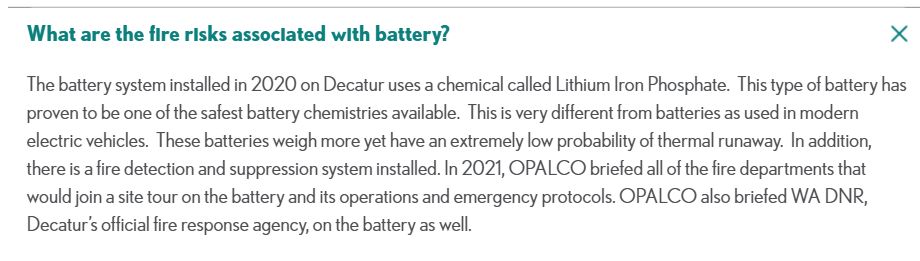
DNR said the June plan’s command language needed correction and that the written acknowledgment described in the plan had not occurred. Its role concerns wildfire originating at, or threatening, the facility.
The page Foster offers as reassurance names DNR in its battery-risk answer. DNR says battery fires are outside its role.
Foster says the plan has been revised. Publish that revision, correct the public explanation, and identify who has accepted the remaining response responsibilities.
San Juan Island Fire & Rescue · Fire District #3 · November 9, 2026
The district’s answer is specific.
“District records indicate that OPALCO has not formally requested coordination with Fire District #3 regarding its projects, operational plans, or emergency response strategies.”
Chief Noel Monin also states that the district has no public-private agreement with OPALCO to provide specialized fire, rescue or emergency-response services supporting those activities.
The district allows for outside-jurisdiction assistance through established agreements. Wildland response under its DNR agreement depends on that agreement’s terms and resource availability. This is not a statement that all assistance is impossible.
Read the district’s full substantive response ↓Lopez Island Fire & EMS · November 9, 2026
He reviewed the draft.
His questions went unanswered.
Foster’s November 5 letter describes agency comments and response responsibilities being addressed through the permitting process. Four days later, Lopez Fire Chief Adam Bigby reports unanswered questions about the draft plan:
“I have seen the draft plan and submitted questions, but they were never answered.”
He says those questions concerned the lack of dispatching and communications with Decatur’s brigade and the communication difficulties created by Decatur’s lack of a fire district. He does not identify the recipient or date of his submitted questions. His response does establish a concrete issue that the current plan and its review record need to resolve.
Read Chief Bigby’s full response ↓01 · The 2021 visit
“It was informational.”
Bigby confirms attending the tour OPALCO cites. He calls it informational and says Lopez Fire has no standing agreement with OPALCO. Attendance should not be presented as evidence that the district accepted a facility-specific response obligation.
02 · Assistance is conditional
Officers decide when asked.
Lopez has a DNR agreement for wildland assistance when staffing is available and operates under the countywide mutual-aid agreement. Its officers determine whether resources permit a response at the time of a request.
03 · What can reach Decatur
What fits on the boat.
“We are limited by the tools we can carry on the Sheriffs boat”
Bigby says most responses would be for EMS or wildland fire. For a battery incident, he describes protecting surrounding grounds through wildland firefighting.
04 · Warning residents
He points to County DEM.
Bigby says all notifications would run through the County Department of Emergency Management. He expects a request for assistance would likely come from Decatur’s brigade or DNR. Those statements need to connect to a documented procedure for dispatch, requests for aid and protective instructions to residents.
His conditional assessment assumes self-contained suppression systems, while leaving dispatch and communications questions unresolved. Foster calls the concerns “unnecessary alarm.” A chief who reviewed the draft says his dispatch and communications questions went unanswered. Publish those questions, the answers and the current response procedure.
Shaw Island Fire Department · FD #5 · November 7, 2026
Shaw also responded: no visit or plan review.
Chief Jon Shannon answered “NO” to participation in the 2021 briefing or a later site visit, and “NO” to review or acknowledgment of the June 2026 plan, acceptance of a role under it, or review of a separate BESS response plan.
He cites the countywide mutual-aid agreement and says deployment and use of personnel and equipment depend on the incident. Asked about warnings and protective instructions for residents, Shannon points to incident command and identifies the Sheriff as incident commander in areas outside fire districts.
Read Chief Shannon’s five answers ↓San Juan County · Capital Facilities Plan
The County’s
own account.
The response limits are already in writing.
“Unnecessary alarm”?
Read the risk and the response record together.
01 · OPALCO’s own risk assessment
For an existing substation-vault fire, OPALCO’s June 2026 fire plan assigns:
The listed controls are immediate de-energization by OPALCO Operations and access restriction during the fire.
June fire plan, §3.2, p. 3 ↗02 · The CWPP’s regional stakes
The Community Wildfire Protection Plan describes mainland electricity arriving at Decatur and being distributed to the other electrified islands. It lists the substation, community solar and battery installation together as critical infrastructure.
This makes the protection question relevant beyond the proposed solar panels and beyond Decatur’s shoreline.
CWPP, printed pp. 40–41 (PDF pp. 49–50) ↗03 · The CWPP records a coordination gap
Its Appendix B agency profile expressly describes an:
“absence of a coordinated emergency communications and response plan for SJC’s outer islands”CWPP, Appendix B, printed p. 79 (PDF p. 88) ↗
The severity rating applies to the existing substation vault, not the battery or the entire project. The June plan is a historical version; Foster says revisions have been made. Regional importance does not establish that every incident would cause a countywide outage.
Low likelihood does not resolve critical consequences. The public is entitled to see how the documented response gaps have been closed.
The facilities plan identifies the practical limits.
Water supply. Difficult access. Delayed response. Personnel and equipment that must travel between islands. San Juan County’s Capital Facilities Plan describes these persistent constraints. Decatur has no serving fire district.
- Water supply
- Difficult island access
- Delayed response
Mutual aid
“Non-feasibility of mutual aid, except for major fire and EMS call.”County plan, printed p. 49 (PDF p. 53) ↗
State assistance
“State assistance for major fires is not available outside of fire districts.”County plan, printed p. 50 (PDF p. 54) ↗
These are statements in the County’s published plan, not a conclusion that every form of aid is barred. Officials should clarify their scope and identify the current arrangements that apply to Decatur.
Which agencies can act, under what conditions, and what protects residents if outside assistance is delayed or unavailable?
OPALCO’s own comparison
Safer chemistry still needed
a response at Bailer Hill.
For Bailer Hill, OPALCO selected Invinity vanadium-flow batteries. The manufacturer describes their electrolyte as nonflammable and water-based.
OPALCO nevertheless emphasized fire monitoring, containment and emergency procedures, and publicly promised training for a named department: San Juan Fire and Rescue.
| Issue | Bailer Hill proposal | Operating Decatur facility |
|---|---|---|
| Battery | Vanadium-flow technology; electrolyte advertised as nonflammable. | Lithium iron phosphate. OPALCO cites comparatively low thermal-runaway susceptibility and installed safeguards. |
| Agency preparation | OPALCO publicly promised training for San Juan Fire and Rescue. | FD#3 identifies no formal coordination request and no OPALCO agreement for specialized services. |
| Setting | An open site on San Juan Island, where San Juan Fire and Rescue operates. | An outer island without a serving fire district, with transport and access still central to any outside response. |
| What must be shown | The training commitment was prospective; completion is not established here. | The current battery plan, accepted agency roles, training, equipment and deployment arrangements. |
Different technologies and sites require different assessments. This comparison concerns OPALCO’s explicit response-planning commitments, not a claim that the two projects have identical hazards or that Bailer Hill training occurred.
OPALCO’s Bailer Hill commitments ↗Invinity’s OPALCO announcement ↗Manufacturer’s chemistry description ↗
OPALCO’s own Bailer Hill approach recognized that equipment safeguards and responder preparation belong together.
OPALCO’s own permitting argument
One integrated facility.
Plan for all of it.
In its August 25, 2025 letter seeking utility-facility treatment, OPALCO expressly compared the proposed solar panels with other substation components, including battery systems. Its conclusion:
“it is the integrated function that matters, not each component in isolation.”
OPALCO letter to San Juan County DCD, Exhibit OPALCO-12, PDF page 3. Read the supporting passage ↓
01
OPALCO described the operational connection. It said the proposed panels would integrate with the substation and connect directly to its transmission and distribution infrastructure.
02
OPALCO pursued boundary changes affecting the facility properties. The permitting history includes LANDUSE-25-0054 and the recorded LANDUSE-26-0011 modification. The County’s later account says an earlier anticipated transfer was not completed. This argument does not depend on treating all parcels as legally merged.
03
The June fire plan addressed the substation vault but omitted the operating battery. If separate or revised plans now fill that gap, publish them and show how the responsibilities and procedures connect.
“No additional battery” does not answer the safety question for the integrated facility OPALCO itself described.
The review should explain how an incident in one part of the facility could affect adjoining equipment, access, surrounding forest and residents, and who can carry out the coordinated response.
Reading Foster Hildreth’s letter · November 5, 2026
Assurances are not
accepted response roles.
Foster’s letter identifies safeguards, utility crews and a review process. It leaves the decisive question unanswered: which agencies have accepted the emergency duties, and what personnel, equipment and access arrangements make that response possible?
Read Foster’s November 5 letter below ↓Original on County portal (.msg) ↗
“Unnecessary alarm”Low likelihood does not resolve critical consequences.
OPALCO’s June fire plan rates an existing substation-vault fire “Low” likelihood and “Critical” severity. The CWPP identifies the co-located substation, solar and battery as critical infrastructure, while its agency profiles record a missing coordinated outer-island communications and response plan. The Capital Facilities Plan documents transport, water and mutual-aid constraints.
Lopez Fire’s chief now says he reviewed the draft and submitted dispatch and communications questions that were never answered. Read his November 9 response ↑
Foster acknowledges that low risk still requires prevention and response planning. The necessary next step is to show the current plans and the accepted, usable response arrangements. Read the exact ratings, qualifications and linked sources ↑
“No additional battery storage”The existing battery is already operating.
No additional battery is proposed. The question is how the existing battery and the connected facility are protected today. OPALCO’s own integrated-facility argument makes that relationship relevant. Separate component plans can work only if their procedures and responsibilities connect.
Safer chemistry, detection and suppressionThose safeguards leave response duties to be established.
Credit the safeguards OPALCO describes. Then publish the equipment-specific emergency procedures and identify who will implement them if an incident exceeds those safeguards. Bailer Hill demonstrates that OPALCO itself contemplated agency training even for a battery technology advertised as using nonflammable electrolyte.
Line crews available 24 hours a dayWho performs the emergency functions beyond electrical support?
Foster describes line crews supporting electrical safety and coordination with emergency responders, with travel dependent on weather and marine access. His letter does not identify who provides specialized fire response, incident command, protective zones, evacuation or sheltering decisions, or sustained monitoring. Those responsibilities need an operational connection to the utility crews.
DNR did not declare the project unsafeDNR did identify limits that the plan must respect.
Correct: DNR did not recommend stopping the project or pronounce it unsafe. It clarified the limits of its role, called for corrected command language, and said the plan’s written acknowledgment had not occurred. Those findings warrant answers without attributing a project-rejection recommendation to DNR.
DNR’s requested changes have been incorporatedPublish the revision and the accepted responsibilities.
Foster says changes have been made. The dated revision and agency responses would let readers assess them. Correcting an assignment in a document leaves a practical question: who has accepted the responsibilities that remain?
DNR also raised vegetation and clearance concerns. Its preference for 100 feet around equipment pads and transformers was a stated preference, not a universal code requirement. The revised plan should explain how those concerns were resolved.
Fire safety was addressed during permittingA review process is not the same as a demonstrated response.
Foster’s letter describes work toward an approved Fire Mitigation Plan. Publish the actual decision, operative plan and supporting agency arrangements. References to hearing materials do not by themselves identify who is committed and equipped to act.
Clearing improves defensible spacePrevention benefits do not establish responders.
The engineering and arborist report does conclude that the proposed layout offers fire-protection benefits. Its fire discussion does not establish agency commitments, transport or battery-response arrangements. Explain how the final layout and emergency procedures work together.
Nearby industrial uses and prior loggingThe report still describes forested land.
Neighboring development and logging history provide context. The report Foster cites also describes approximately 20 acres of forested land and mature conifers in one proposed array area. Those descriptions should remain visible when OPALCO characterizes the site.
Getting help to Decatur
A fire plan has to
cross the water.
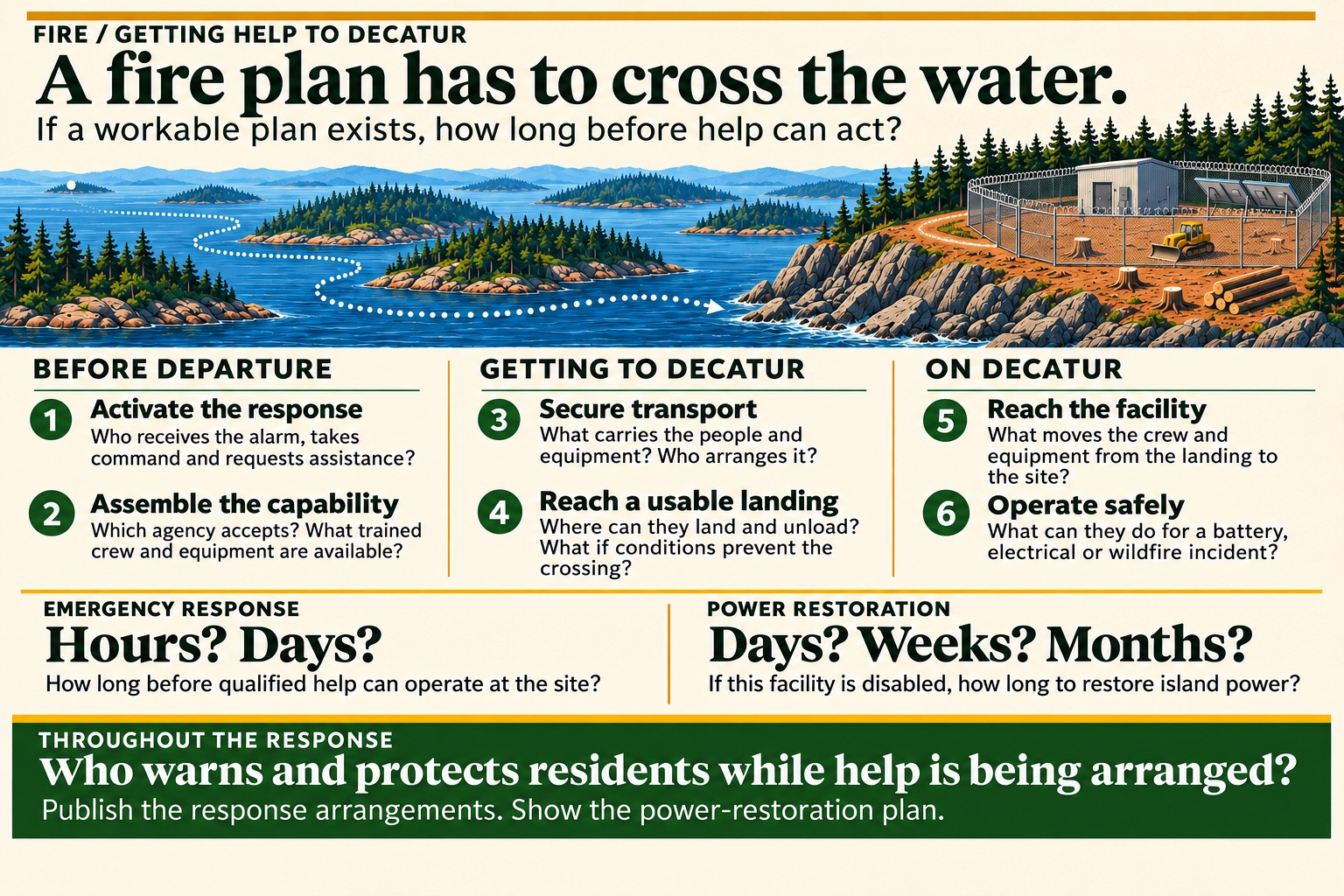
Read the six response steps
- Activate the response: Who receives the alarm, takes command and requests assistance?
- Assemble the capability: Which agency accepts, and what trained personnel and equipment are available?
- Secure transport: What carries the people and equipment, and who arranges it?
- Reach a usable landing: Where can they unload, and what if conditions prevent the crossing?
- Reach the facility: What moves the crew and equipment inland?
- Operate safely: What can they do for a battery, electrical or wildfire incident?
Throughout the response, who warns residents, communicates protective instructions and determines when the danger has passed?
Liability & financial responsibility
Who pays when
the plan fails?
PG&E pleaded guilty to 84 counts of involuntary manslaughter for the 2018 Camp Fire. Separately, it agreed to a settlement valued at $13.5 billion for individual claims arising from several fires, including the Camp Fire.
Utility fire failures can carry consequences far beyond damaged equipment.
San Juan County belongs to the Washington Counties Risk Pool. A state audit found the pool approximately $25.3 million short of its total-asset solvency requirement at the end of 2025.
Before expansion, OPALCO and the County should disclose accepted response responsibilities, applicable liability coverage and who bears losses beyond that coverage.
Insurance cannot supply missing responders. A settlement cannot restore a life.
Read the liability sources and scope
The settlement covered several fires; the manslaughter counts concerned the Camp Fire. The risk-pool shortfall is a dated finding about County coverage, not evidence about OPALCO’s insurance. These comparisons do not assert that OPALCO or County officials have committed a crime or that liability has been established.
The answers residents should be able to rely on
Publish the arrangements.
Demonstrate the response.
- The current plans: the revised fire plan and the operating battery’s emergency procedures, with their relationship explained.
- The agency questions and answers: publish Chief Bigby’s submitted questions, any responses and the plan changes that resolve dispatch and communications.
- The accepted roles: agencies, incident command, dispatch and public-warning responsibilities, with the relevant agreements.
- The usable capability: trained personnel, equipment, transport, landing and access arrangements, and sustained support.
- The plan for delay: how residents and neighboring property are protected if outside help cannot arrive promptly.
Distinguish what is operational today, what is proposed and what remains unestablished.
OPALCO’s June plan acknowledges critical severity for a substation-vault fire. The CWPP identifies the site as critical infrastructure. DNR, Fire District #3 and Lopez Fire describe limits on their response. Lopez’s chief also reports unanswered dispatch and communications questions. The public is entitled to see how those limits have been addressed.
Calling the questions “unnecessary alarm”
does not answer who will come.
Show the people, the equipment and the agreements that turn reassurance into a response.
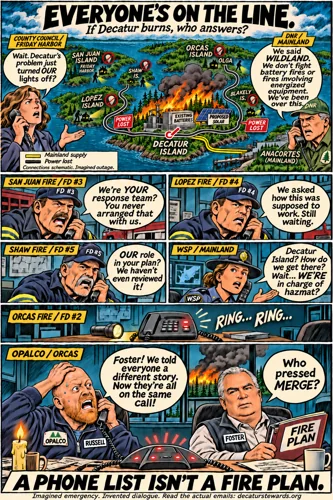
Visual explainers
The fire cartoons
A different way to look at the same questions.
Read the documents behind the comparison
The source record.
New correspondence is reproduced below as readable text. Personal email addresses, telephone numbers, routing headers and mail-security notices are omitted. Substantive wording is retained; excerpts are identified.
OPALCO · Foster Hildreth · November 5, 2026Decatur Solar Expansion, Fire Safety and Permit Review
OPALCO Directors and Community Leaders,
I am writing to put the fire concerns raised in Mr. Mizuta’s October 29 correspondence into perspective.
The Decatur Solar Expansion project proposes installing solar panels, with no additional battery storage. OPALCO’s published assessment considers the proposed installation’s fire risk low when supported by proper engineering, installation, inspection, and maintenance. Fire safety was also addressed during the County’s review, as reflected in the February hearing materials. The project incorporates certified equipment, electrical protection, monitoring, and ongoing vegetation management.
The location and history of the site provide important context.
The expansion site is adjacent to OPALCO’s substation, the existing Decatur Community Solar project (Phase 1), the San Juan County Public Works yard, two large storage buildings, a previous junkyard and the site has been logged multiple times. Power generated on Decatur flows first to local loads, serving the community that hosts the project.
The existing battery energy storage system, installed during Phase 1, uses lithium iron phosphate chemistry, which has a comparatively low susceptibility to thermal runaway. It also includes fire detection and suppression equipment. These features provide additional layers of protection for the existing installation.
The engineering and arborist report identifies potential fire protection benefits from the expansion. The proposed layout, together with removal of dense undergrowth and continued vegetation management, would reduce fuel continuity and improve defensible space around the existing substation. Those findings deserve consideration in any balanced assessment of the project’s fire safety compared with the site’s existing condition.
As standard practice, OPALCO maintains line crews on standby 24 hours a day, seven days a week for emergency callouts, including to Decatur and other outer islands. This established utility response capability supports electrical safety and coordination with emergency responders, with travel times dependent on weather and marine access.
Mr. Mizuta’s correspondence portrays questions about emergency response and comments on a draft plan as evidence that the expansion presents an unacceptable danger. That portrayal overstates what the cited information establishes and creates unnecessary alarm. DNR’s email raises matters that require attention; it does not conclude that the project is unsafe or recommend stopping it. Staff have already incorporated the plan changes requested by Washington DNR.
OPALCO is following San Juan County’s permitting requirements, including working with the County Fire Marshal toward an approved Fire Mitigation Plan. Agency comments, vegetation management, and emergency response responsibilities are being addressed through that process. We recognize that low fire risk still requires appropriate prevention and response planning.
Supporting reports and responses to community questions are available on OPALCO’s website:
Decatur Solar Expansion project page
www.opalco.com/decatur-island-solar-project/
October 2026 consolidated Questions and Answers
www.opalco.com/wp-content/uploads/2026/10/QAwithTOCDecatur_10-26.pdf
San Juan Island Fire & Rescue · Chief Noel Monin · November 9, 2026Response to Island Neighbors for Conservation
Dear Island Neighbors for Conservation:
Fire District #3 has no legal obligation or contractual commitment to provide services outside its jurisdictional boundaries. The District's response to incidents beyond its jurisdiction is governed by established interlocal and mutual aid agreements with federal, state, and local public agencies. Specifically, wildland fire response within areas protected by the State of Washington may be provided through the District's Interlocal Agreement with the Washington State Department of Natural Resources (DNR), subject to the terms of that agreement and resource availability.
District records indicate that OPALCO has not formally requested coordination with Fire District #3 regarding its projects, operational plans, or emergency response strategies. The District does not have a public-private agreement with OPALCO to provide specialized fire, rescue, or emergency response services in support of those activities.
Scope: The district’s statement concerns formal coordination and agreements. It does not establish whether any individual attended a past informational briefing or rule out conditional assistance through other agreements.
Lopez Island Fire & EMS · Chief Adam Bigby · November 9, 20262021 tour, conditional aid and unanswered plan questions
Thank you for reaching out,
1. Yes I did attend the site tour in 2021, it was informational. Opalco does not dictate how we respond to emergencies and there was no reason to enter into any agreements with Opalco as they are not an emergency response agency nor does this facility fall into our Fire District primary response area.
2. We have a response agreement with DNR for wildland assistance when we have available staffing. Lopez Island Fire and EMS also operate under the County Wide Mutual Aid Agreement with all other fire districts in San Juan County. Our officers determine at the time of request whether we have the resources to respond. There is no need for a specific battery plan as I have been informed that the Decatur battery system houses their own extinguishing systems. As with any Li ion battery fire, if they ignite the best measure is to protect exposures and let the battery discharge all its energy. Any request for assistance on Decatur would likely come from the Decatur Fire Brigade or DNR.
3. We are limited by the tools we can carry on the Sheriffs boat, in most cases we would only respond for EMS or wildland fire calls due to Decatur lacking any structure protection equipment or support supplies. In the case of an issue with the battery system on Decatur, we would protect surrounding grounds through wildland firefighting efforts
4. I have seen the draft plan and submitted questions, but they were never answered. My questions revolve around the lack of dispatching and communications with the Decatur Fire Brigade and how the lack of a fire district on Decatur makes for difficult communications in any situation. The plan looked workable to me if the units have self-contained suppression systems.
5. All notifications would run through the County Department of Emergency Management
As I stated above, Lopez Island Fire and EMS does not have any standing agreements with Opalco, we operate under the County Wide Mutual Aid agreement
Adam Bigby
Fire Chief
Lopez Island Fire & EMS
Read the qualifications: Chief Bigby describes existing mutual-aid arrangements, with response dependent on staffing and an officer’s assessment of resources. His conditional assessment assumes self-contained suppression systems, while leaving dispatch and communications questions unresolved. The absence of a standing agreement with OPALCO does not establish that assistance is unavailable.
Shaw Island Fire Department · Chief Jon Shannon · November 7, 2026Five answers on participation, plans, mutual aid and incident command
Question 1. Did your district participate in the 2021 briefing or a later site visit? Did that participation result in an agreed operational role, or was it informational only?
Chief Shannon: NO
Question 2. Does your district currently have a standing agreement, dispatch protocol, or other authorization to respond to an incident at the Decatur facility? Please identify the arrangement and whether it covers battery or electrical incidents, wildland fire, or another defined role. If assistance would depend on a discretionary request and available resources, please explain that distinction.
Chief Shannon: All the Fire Districts in San Juan County are party to a Mutual Aid Agreement. That document can be found in the recorded documents through the Auditor’s office. The document # is 2005 0708044.
Question 3. What functions could your district perform, and what limits apply? Please address relevant training, equipment, transportation to and access on Decatur, and the conditions that would affect deployment. We recognize that an appropriate response may involve isolation, exposure protection, or monitoring rather than direct suppression.
Chief Shannon: All of the factors listed above are incident specific. The incident commander is responsible for the deployment and utilization of personnel and equipment resources based on those factors.
Question 4. Has your district reviewed or acknowledged the June 2026 plan, accepted any role under it, or reviewed a separate response plan for the operating BESS? If so, please identify the plan or arrangement and whether you consider it operationally workable.
Chief Shannon: NO
Question 5. Who would determine and communicate any exclusion zone, evacuation, or shelter-in-place instructions for island residents, particularly before responders reach the site? Is your district assigned a role in that process?
Chief Shannon: Incident command. The Sheriff is the incident commander in all areas of the county not served by a fire district.
Island Neighbors for Conservation · November 7, 2026, 9:41 a.m. PacificThe request for comment sent to Lopez Fire
Chief Bigby,
Island Neighbors for Conservation is preparing a report on emergency-response arrangements for OPALCO's Decatur Island substation, existing solar installation, operating battery energy storage system (BESS), and proposed solar expansion. We are contacting the island fire districts individually to establish what role, if any, each has agreed to perform.
OPALCO's project webpage says it briefed participating fire departments on the battery and emergency procedures in 2021. In the same discussion, it presents DNR as the designated agency for fire response on Decatur.
DNR's attached response clarifies that its responsibilities cover wildland fire and do not include battery or other non-vegetation fires. Jason McMillen says the broad command role assigned to DNR in Section 5.3 of OPALCO's June 2026 Fire Mitigation Plan needs correction. He also expressly says he had not contacted the other fire districts about their response capabilities.
Section 9 of that plan anticipates coordination with assisting fire districts before commissioning, but does not name them. Decatur has no serving fire district, and the Decatur Emergency Brigade does not provide structural or electrical-infrastructure firefighting. We are seeking your district's account of any arrangements that exist.
Please address the following for Lopez Island Fire & EMS:
- Did your district participate in the 2021 briefing or a later site visit? Did that participation result in an agreed operational role, or was it informational only?
- Does your district currently have a standing agreement, dispatch protocol, or other authorization to respond to an incident at the Decatur facility? Please identify the arrangement and whether it covers battery or electrical incidents, wildland fire, or another defined role. If assistance would depend on a discretionary request and available resources, please explain that distinction.
- What functions could your district perform, and what limits apply? Please address relevant training, equipment, transportation to and access on Decatur, and the conditions that would affect deployment. We recognize that an appropriate response may involve isolation, exposure protection, or monitoring rather than direct suppression.
- Has your district reviewed or acknowledged the June 2026 plan, accepted any role under it, or reviewed a separate response plan for the operating BESS? If so, please identify the plan or arrangement and whether you consider it operationally workable.
- Who would determine and communicate any exclusion zone, evacuation, or shelter-in-place instructions for island residents, particularly before responders reach the site? Is your district assigned a role in that process?
If no standing response commitment exists, a clear statement to that effect would be useful. We want to distinguish an established capability from possible assistance and avoid attributing responsibilities your district has not accepted.
Please respond by Friday, November 13, 2026, at 5 p.m. Pacific. We intend to include your response in our reporting at decaturstewards.org. If additional time is needed, please identify the person handling the inquiry and when a substantive response can be expected.
Thank you,
Island Neighbors for Conservation
https://decaturstewards.org
Supporting material:
Attachment: DNR_Decatur_Response_Redacted.pdf
DNR’s response is reproduced and linked in this source record.
OPALCO project webpage, battery fire-risk discussion:
https://www.opalco.com/decatur-island-solar-project/
June 2026 Fire Mitigation Plan, especially Section 5.3 (page 6) and Section 9 (page 7):
Published June 2026 plan
Washington DNR · October 26, 2026Wildfire role, command language and acknowledgment
“DNR will only be assuming command if there is a wildland fire started from their facility or if a wildland fire is threatening their facility. As you know DNR does not fight structure, vehicle, trash, battery, or non-vegetation fires.”
“I will be reaching out to OPALCO and asking them to make sure that is rewritten to reflect that.”
“I did review the plan, but no one has acknowledged the plan in writing for the DNR as stated in Section 9.”
DNR’s response also discusses vegetation and clearance concerns. Its preference for 100 feet around equipment pads and transformers was not stated as a universal requirement.
OPALCO · August 25, 2025 · Exhibit OPALCO-12The integrated-facility argument
“The solar panel expansion is ancillary to the existing utility use. The proposed solar panels will be integrated into the substation’s operations and directly tied into OPALCO’s Transmission and Distribution infrastructure.”
The same paragraph compares the panels with capacitor banks, transformers and battery systems as components supporting utility operations. It concludes:
“it is the integrated function that matters, not each component in isolation.”
Parcel-history note: The October 1, 2026 staff report for LANDUSE-26-0123 discusses LANDUSE-25-0054 and LANDUSE-26-0011 on pages 8–11. It says the anticipated transfer associated with the earlier configuration was not completed, and identifies LANDUSE-26-0011 as recorded under AFN 2026-0218013. No conclusion that all parcels have legally merged is asserted here.
Earlier public correspondenceNotification, battery readiness and County review
County background and OPALCO’s fire plan
- County Capital Facilities Plan, PDF pages 53–54 ↗
Fire protection and EMS, §7.3.7, printed pages 49–50. The County describes access, water supply, response time, mutual-aid constraints, and insurance-rating implications. - OPALCO’s June 2026 Fire Mitigation Plan ↗
See §4.2 on vegetation and clearance, §5.3 on command, and §9 on coordination and acknowledgment.
DNR’s response and clearance concerns
DNR’s October 26 response distinguishes its wildfire role, says the written acknowledgment described in the plan had not occurred, and raises clearance and vegetation concerns.
The plan specifies ten feet around equipment pads and transformers. DNR expressed a preference for 100 feet and no vegetation beneath the arrays, where the plan allows growth up to 24 inches. The 100 feet is a stated preference, not an established universal requirement.
Hi [name redacted].
Apologies for not responding to this sooner. Krista Bouchey sent the plan out in June and asked that I review it, and I responded to her in August. I did have some concerns regarding the vegetation under the solar panels and defensible space around the site.
I did not receive a written response, but a gentleman from OPALCO called me to discuss my concerns. I told OPALCO the DNR is concerned if their infrastructure starts a fire or a fire that started off their site moves towards or onto their site. I also asked that they include DNR in their emergency contact in case of a fire since DNR was not originally listed as a contact.
You just brought 5.3 to my attention. DNR will only be assuming command if there is a wildland fire started from their facility or if a wildland fire is threatening their facility. As you know DNR does not fight structure, vehicle, trash, battery, or non-vegetation fires. We would work closely with the local fire brigade and San Juan County to establish joint Incident Command with those agencies in the event of a wildfire on or near their facility. I will be reaching out to OPALCO and asking them to make sure that is rewritten to reflect that.
1. I did review the plan, but no one has acknowledged the plan in writing for the DNR as stated in Section 9. My original concerns:
4.2
• Vegetation height under arrays shall not exceed 24 inches during fire season (June 1 - October 31)
It would be better if there was no vegetation growing under your solar array.
My concern - A 10-ft cleared and maintained perimeter shall be established around each equipment pad and transformer.
If an electrical incident occurred that caused sparks how far could those sparks reach? Is a 10’ cleared area going to be adequate? 100’ is preferred.
5.1
• Upon discovery of fire or smoke on or near the solar facility: 1. Call 911 immediately. State location as: Decatur Island Substation and Solar Site, 668 Decatur Head Dr., Decatur Island, WA.
My concern - In addition to 911 call DNR Dispatch immediately: [phone redacted]
2. As I mentioned above, DNR will only respond if there is a wildfire started by or is threatening the site. A good example is if the site had an event that started a fire in the winter where there is no threat of a wildfire, DNR is not responding.
3. I am not aware of any organization other than DEB that would respond to this type of an event on Decatur and I have not talked to any of the Fire Districts or County Fire Marshal about their response, or ability to work on this type of incident.
I know there is a misconception that DNR is the Fire Department for folks in San Juan County that live outside a fire district. We only fight wildland fires and do not respond to any other type of fire or event unless its threatening DNR jurisdiction.
Thank you for reaching out with these questions, you brought a couple of items to my attention that I will be addressing with OPALCO.
Sincerely.
Jason McMillen
Salish Unit Fire Management Officer
Northwest Region, WA Department of Natural Resources
[phone redacted]
[email redacted]
www.dnr.wa.gov
Earlier questions and correspondence
- September 7, 2023: Emergency-notification questions ↗
- June 22, 2026: Countywide coordination and PulsePoint request ↗
- September 18, 2026: DNR’s assigned role questioned ↗
- September 21, 2026: Existing battery readiness ↗ and fire review for Conditions 7 and 11 ↗
- October 26, 2026: DNR response and letter to County leadership and OPALCO Directors ↗
Letter to County leadership and OPALCO Directors
Councilmembers, OPALCO Directors, and County leadership:
Read DNR’s forwarded email below. Then explain why this project is still moving. OPALCO’s fire plan relies on DNR, yet DNR’s wildland responsibilities do not include fighting battery or energized-electrical fires. No agency in the county has been identified with the expertise, equipment, and commitment to fill that gap. That is the final nail in the coffin of OPALCO’s claim that the Decatur expansion is responsibly planned. You have been warned repeatedly. Every decision to advance this project now is a decision to proceed with those failures in plain view.
For years, I have raised fundamental questions about fire protection, emergency notification, and life safety on the outer islands. The correspondence documents warnings, practical proposals, offers to help, and repeated requests for answers. What remains missing is a reliable system that people can count on when something goes wrong.
The most basic failure begins with SJC 911.
In September 2023, we were told that dispatch would discontinue its longstanding practice of notifying outer-island community responders of fire and medical emergencies. My September 7, 2023 email asked how the County would replace that connection, explain the change to residents, and address the consequences. My June 22, 2026 request for countywide coordination and PulsePoint implementation returned to those same unanswered questions.
A person can call 911 while trained neighbors with equipment remain unaware that help is needed nearby. On islands where outside assistance depends on boats, aircraft, weather, and available personnel, that gap can consume the only minutes that matter.
Outer-island communities have organized volunteers, bought equipment, arranged training, and raised money to help themselves. The County’s job is to connect that local capacity to its emergency-notification system. Geography creates unavoidable difficulties. Leaving known gaps unresolved is a choice.
The Council-adopted 2012 Community Wildfire Protection Plan already recognized the need to support outer-island brigades and improve coordination. The 2025 CWPP again calls for better outer-island communications, marine response, coordinated protocols, and training. Treating those commitments as shelfware is a slap in the face to the professionals and volunteers who developed them, and to the communities relying on them. Adopting a plan and failing to carry it out is not preparedness.
The Decatur project brings that institutional failure into sharp focus.
OPALCO has no business expanding this facility while basic questions about protecting what is already operating remain unanswered. That failure alone is grounds to stop this project.
DNR deserves credit for responding directly and clarifying its role. Its response exposes how much OPALCO’s planning depends on assumptions about emergency services that have not been demonstrated. It is indefensible that residents have to chase down the agencies named in a fire plan to discover what they can actually do.
A credible plan identifies who will act, what they will do, and what resources make that possible. The linked correspondence repeatedly asks for those answers. Referrals, assurances, and promises of future coordination do not supply them. The public has been doing the homework that OPALCO and the County needed to do before advancing this project.
The deficiencies are fundamental:
• The battery was already there, but the fire plan left it out. OPALCO’s June 2026 plan omitted the operating battery energy storage system (BESS), despite its location alongside the substation, existing solar array, and proposed expansion. My September 21 warning to the Council and OPALCO Board asked what protects that existing facility before this model expands. This is exactly what the warnings about battery readiness were intended to prevent.
• One facility for permitting, separate pieces for responsibility. The original installation proceeded through a Provisional Use Permit (PUP). That history includes reported wetland filling and installation of the BESS. OPALCO repeatedly sought the same permitting treatment for the expansion, arguing that it was integrated with the substation, and pursued boundary changes to incorporate the property into the same parcel. It cannot claim one integrated facility to secure easier permitting, then draw administrative lines around its responsibility for the hazards.
• DNR’s preferred clearance is 100 feet. DNR identified a preference for 100 feet around equipment pads and transformers , compared with the plan’s ten feet. It also preferred no vegetation beneath the arrays, while the plan allowed growth up to 24 inches (page 4, §4.2). These differences go directly to site design, forest exposure, and maintenance. They demand a substantive response, not another assurance that the paperwork is progressing.
• Naming responders does not create a response. Decatur has no serving fire district. The plan assigns DNR command of fire-suppression operations (page 6, §5.3) , but DNR’s wildland responsibilities do not establish a capability to fight energized electrical equipment or manage a battery emergency. References to unnamed “assisting fire district(s)” (page 7, §9) are empty without identified agencies, accepted responsibilities, transportation, trained personnel, and appropriate equipment. DNR’s response identifies no committed assisting fire district. If the assumption is that DEB will fill that gap, that assumption is wrong. DEB does not provide structural or electrical-infrastructure firefighting. Calling 911 and waiting for an OPALCO employee does not fill that hole. These are elementary facts about outer-island response. Failure to establish them is an indictment of the planning and review by all.
• The consequences extend beyond the fence. Battery hazards, smoke, possible re-ignition, responder access, public warning, evacuation, and prolonged monitoring require a coordinated plan for the entire site and surrounding community. OPALCO’s own plan identifies potentially critical consequences at the substation. An emergency will not respect the boundary of the latest permit application.
• Approval requires competent scrutiny. My September 21 submission to DCD on Conditions 7 and 11 placed these questions directly into the project record. The County must identify who is providing qualified fire-code and battery-safety review, which agencies have accepted their assigned roles, and what capability actually exists. A better-written plan cannot supply missing responders, equipment, access, or defensible space.
The same institutions advancing this expansion have yet to provide clear answers about the emergency system on which its safety planning depends. That failure reaches far beyond one permit and one island.
Stop advancing the expansion. Address the existing facility. Close the 911 notification gap.
The Council must name the person accountable for restoring reliable coordination with outer-island responders and publish a timetable. OPALCO’s Board must require a comprehensive safety review of the existing Decatur facility. DCD must withhold fire-plan approval until the record demonstrates actual capability and agency agreement. If you contend these deficiencies have already been resolved, produce the policies, agreements, technical reviews, and operational evidence.
Provide substantive written responses within 14 calendar days of this email. Reply to all recipients and copy info@decaturstewards.org. Each responsible office and OPALCO must address the issues within its authority, identify who is accountable, and state what action it will take and when. An acknowledgment of receipt or another referral does not answer these questions.
These concerns have already been raised privately, publicly, and repeatedly. I will forward this correspondence and your responses for publication at decaturstewards.org, alongside a clear record of questions left unanswered and commitments left unfulfilled. Residents and reporters will be able to see what you knew, what you were asked to do, and how you responded.
This record will become more public, not less. Silence will become part of that record too.
If the worst happens, the record will not begin on the day of the fire. It will begin with years of warnings and the decisions made while there was still time to act. Whether that conduct amounts to misfeasance or malfeasance will be for others to determine, potentially before a judge or jury. Your own assurances will not settle that question.
I would much rather see you correct these failures now than explain them in a courtroom afterward.
[Name redacted]
OPALCO member and Decatur community member
Submitted in my individual capacity, informed by my work with the Decatur Emergency Brigade. This is not a submission on behalf of the DEB Board.
Original inquiry to DNR
External Email
Hi Jason,
Could you help with a quick clarification based on your own involvement? No need for research or a formal agency response.
OPALCO published the attached plan and presented it to Decatur residents in a brief online meeting. The original PDF link no longer works, and OPACLO’s general manager, Foster Hildreth’s recent letter to San Juan County Department of Community Devleopment represents the fire plan as submitted.
Section 5.3 (page 6) assigns DNR command of fire suppression, while Section 9 calls for DNR’s written acknowledgment. A reader could reasonably understand that DNR has been consulted about this role. The plan does not address the existing battery energy storage system (BESS) beside the proposed expansion.
1. Have you or your team reviewed this plan or acknowledged the assigned role?
2. Does that role fit your understanding of your unit’s capabilities for electrical or BESS incidents?
3. Are you aware of any County plan or district agreements providing a BESS response on Decatur, including trained personnel, equipment, and transportation?
We value your support and want to distinguish OPALCO’s stated expectations from arrangements actually established with responders. Brief answers based on what you know would be very helpful.
Thanks,
[Name redacted]
Decatur Island, WA
Related emergency-response guidance
- County hazardous-materials plan, Appendix C ↗
The framework for agency responsibilities must be connected to an operational response at Decatur. - Powin’s October 2021 emergency-response guide ↗
Published guidance discusses prolonged incidents, re-ignition, and protective measures. OPALCO should identify the current instructions applicable to the equipment installed at Decatur and explain how they will be carried out.
Lopez Fire’s November 9 responseChief Adam Bigby’s response excerpts ↑
The 2021 tour, conditional aid, transport limits and unanswered dispatch questions.
OPALCO’s battery-risk wording, preservedNovember 9, 2026 Wayback snapshot, 21:27:58 UTC ↗
Dated screenshot of the complete FAQ ↑
The historical wording remains available if the live page changes.
Foster Hildreth’s November 5, 2026 letterOriginal County portal document (.msg) ↗
County listing and correspondence date ↗
OPALCO’s likelihood and severity ratingsJune 2026 fire plan, §3.2, p. 3 ↗
Existing substation-vault fire: Low likelihood; Critical severity. This is the June version.
The CWPP: regional infrastructure and coordinationDecatur’s power-distribution role and critical infrastructure, printed pp. 40–41 ↗
Appendix B agency profile, coordination gap, printed p. 79 ↗
OPALCO’s current public explanationProject webpage, including the battery-risk FAQ ↗
Wording reviewed and captured November 9, 2026. Archived version ↗
The June 2026 fire planPublished community version ↗
Historical version; Foster says subsequent revisions have been made.
Bailer Hill response planningOPALCO’s fire-safety and training commitments ↗
Bailer Hill battery technologyManufacturer’s OPALCO announcement ↗
Nonflammable electrolyte description ↗
The County’s response constraintsCapital Facilities Plan, §7.3.7, pp. 49–50 ↗
Earlier questions and correspondenceExisting fire-response source archive ↗
Includes notification, battery-readiness and County-review correspondence.